






Institutions are pledging, lending, and repo’ing tokenized US Treasuries, equities and ETFs on Canton right now. Most of them cannot see that activity on their own books, which means the moment a regulator or auditor asks for proof, someone is reconstructing it by hand instead of pulling it from the ledger.
Through a new partnership with Canton, TRES will join the network as a Validator, the first and only financial data platform in that role. Any institution on Canton will then be able to bring its validator to TRES directly, whoever holds its assets.
Where Canton and DTCC stand today
In December 2025, the SEC issued a no-action letter allowing DTC to tokenize securities it holds in custody. DTCC partnered with Digital Asset to bring that service to Canton, and now co-chairs the Canton Foundation alongside Euroclear. On July 15, 2026, DTCC ran live production trades in tokenized securities, and the full Tokenization Service is scheduled to launch later this month, subject to regulatory clearance.
That launch lands inside a network already moving institutional volume. Broadridge’s Distributed Ledger Repo, built on Canton technology, processed $7.5 trillion of repo in June 2026, averaging $357 billion a day, and J.P. Morgan’s Kinexys is bringing its USD deposit token, JPM Coin, natively to Canton. On a network carrying repo and collateral at that scale, an unbookable position is an audit finding.
Why DTCC tokenized assets are invisible to most financial data platforms
Most financial data platforms reconcile against public data: an indexer or explorer returns every transaction and balance tied to a wallet address.
Canton’s public data only shows the public asset: Canton Coin and network governance. DTCC tokenized Treasuries and equities, and the repo, pledges and lending built on them, run as private transactions, so they never show up there. Each party’s private record sits on its validator, so the only route to an institution’s real positions is a direct connection to that validator.
Today, that connection usually runs through whichever custodian operates the node. An institution’s reporting is therefore only as complete as its custodian’s integrations, and the rest gets rebuilt in spreadsheets before it reaches the general ledger. That dependency is what TRES becoming a Validator will remove.
What banks and financial institutions can solve with TRES
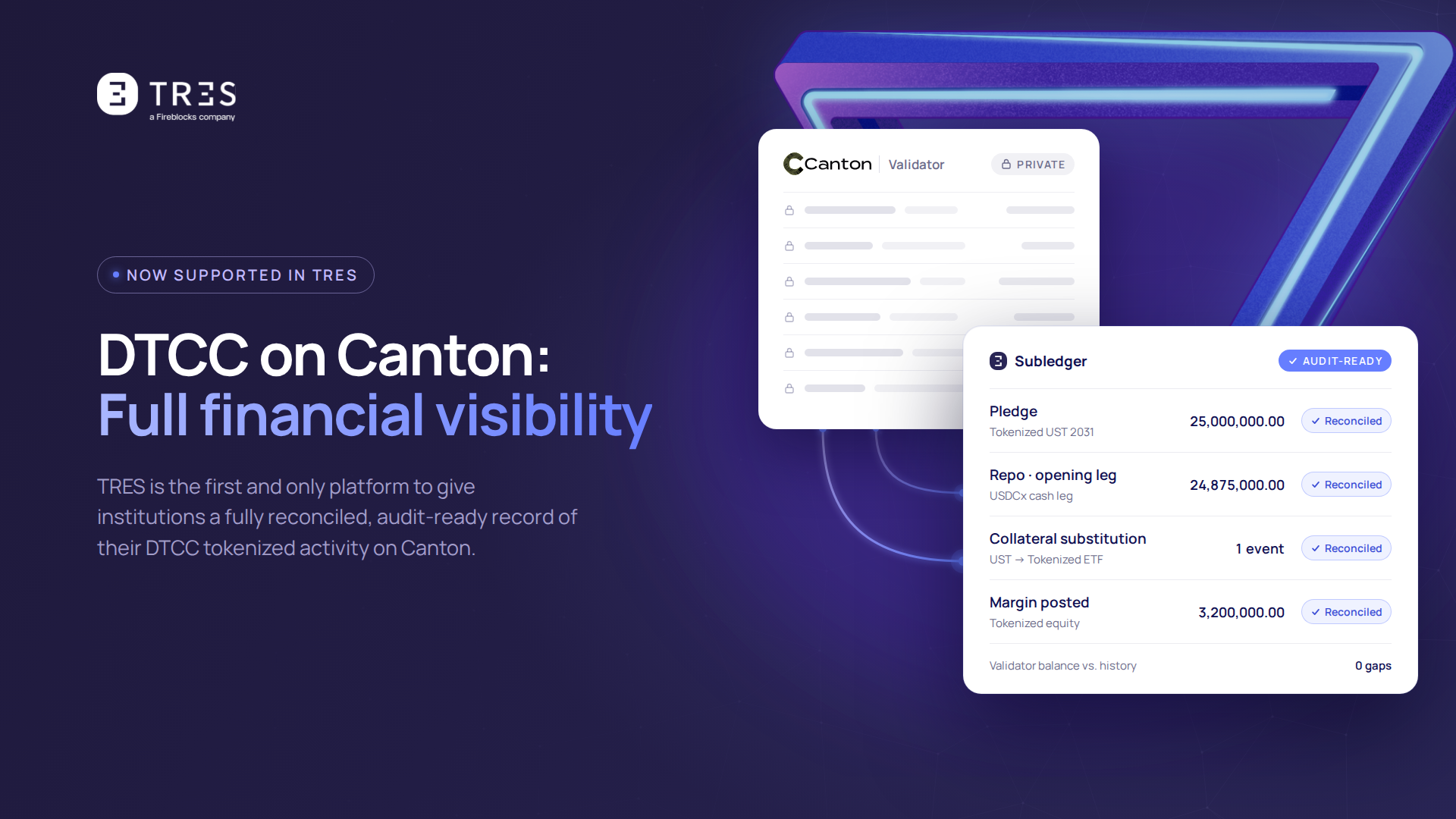
- Reconcile continuously. With Transaction Reconciliation, your team sees a gap between validator-reported balances and transaction history the day it appears, with a verifiable record of how every balance was reached.
- Book the full lifecycle correctly. Your pledges and releases, repo opening and closing legs, and collateral substitutions land as the economic events they are. A substitution is booked as one event, not two unrelated transfers.
- Give your auditors a record they can test. Audit Prep produces a reconciled, timestamped record tied back to the validator’s own data, run on a SOC 1 Type 2 certified platform.
- Feed your ERP directly. Oracle, SAP and NetSuite weren’t built to take in Canton contract events. Your ERP receives them from TRES as journal entries it already understands, with no manual mapping in between.
- Once TRES is a Validator, keep one set of books across every custodian. Positions held with different custodians, or on your own validator, will reconcile into a single record alongside everything else you hold on-chain and off, so adding a custodian or a network won’t add a reconciliation process.
When the Tokenization Service goes live
Tokenized collateral will move onto participants’ books and into their auditors’ scope. With TRES sitting inside the network as a Validator, every institution on Canton will be able to answer for that collateral from one reconciled record, whichever custodian it chose.
Book a demo to see your DTCC tokenized activity in TRES.
Interested in TRES?

