






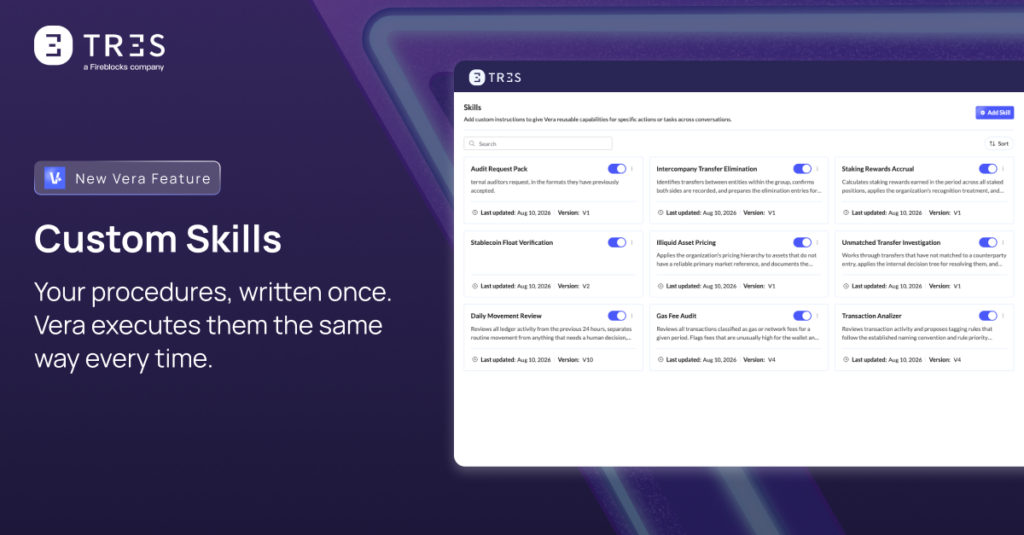
TRES built Vera with a set of built-in skills: reconciliation triage, financial analysis, roll-forward, smart tagging. These cover the accounting work that is broadly the same across most digital asset finance teams.
However, there are many workflows and day-to-day requirements for finance teams that are unique to your business. These are things that are bespoke to how you work, how you categorise and how you account for activity.
No two subledgers are run the same way
Two organizations holding the same assets on the same chains will still operate totally differently. The reporting jurisdiction differs. The auditor differs, and auditors have formats they have accepted and formats they will send back. The ERP mapping differs. The token mix differs. And layered on top of all of that is a set of internal conventions, established at some point by a specific person for a specific reason, that now function as house rules.
This is not confined to simply your close. It runs through the entire operation, and most of it is daily work rather than period-end work. How the team classifies incoming activity. How it reviews what moved overnight and decides what needs a second look. How it prices assets that have no clean market reference. How it books transactions that do not fit an existing category. How it formats a report before it goes to an auditor. How it verifies the ledger before anyone signs anything off. Some of these run every day, some every month, and some only when a particular condition appears.
None of it is written down in an accounting standard. Most of it is not written down anywhere. It survives as practice, carried by whoever has been doing the job longest.
That is a fragile way to run a control-relevant process, and it is the single reason general-purpose AI tools stall in finance. A model cannot follow a rule it has never been told. It can produce something plausible, which in accounting is worse than producing nothing. The only way an assistant reproduces a method correctly is if the method has been made explicit, and the only people who can make it explicit are the ones who run it.
Vera’s ‘Custom Skills’ now solves this exact problem.
What does Vera’s ‘Custom Skills’ do?
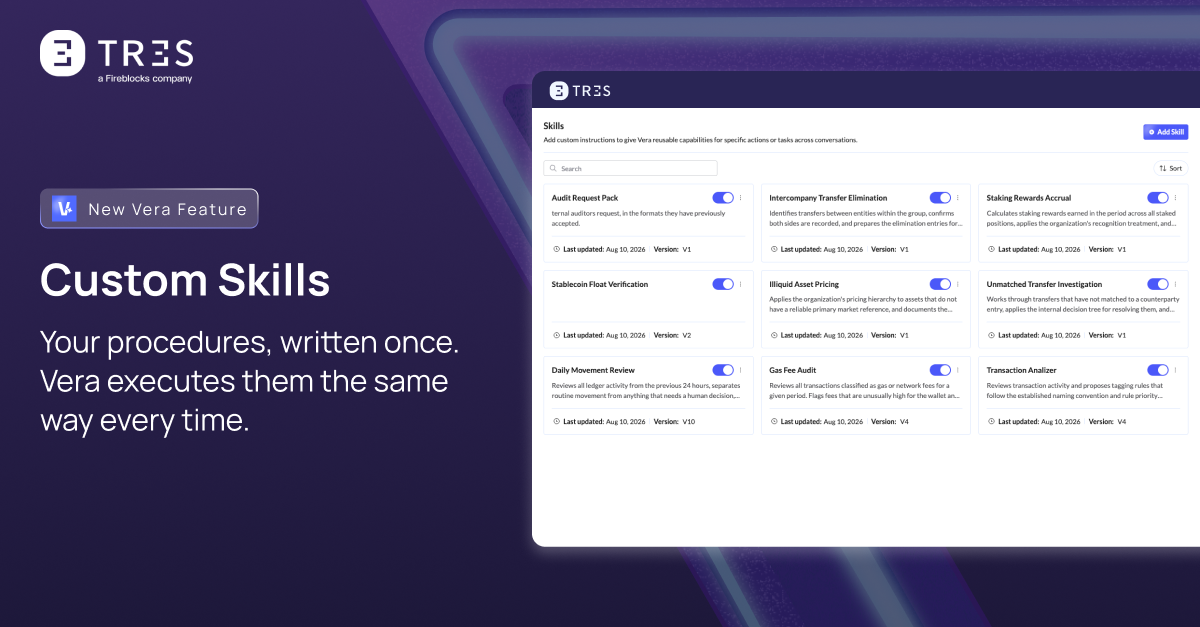
Custom Skills lets an organization define its own internal finance procedures as Vera skills. Each one carries a name, a display name, a description, and step-by-step instructions written in plain language.
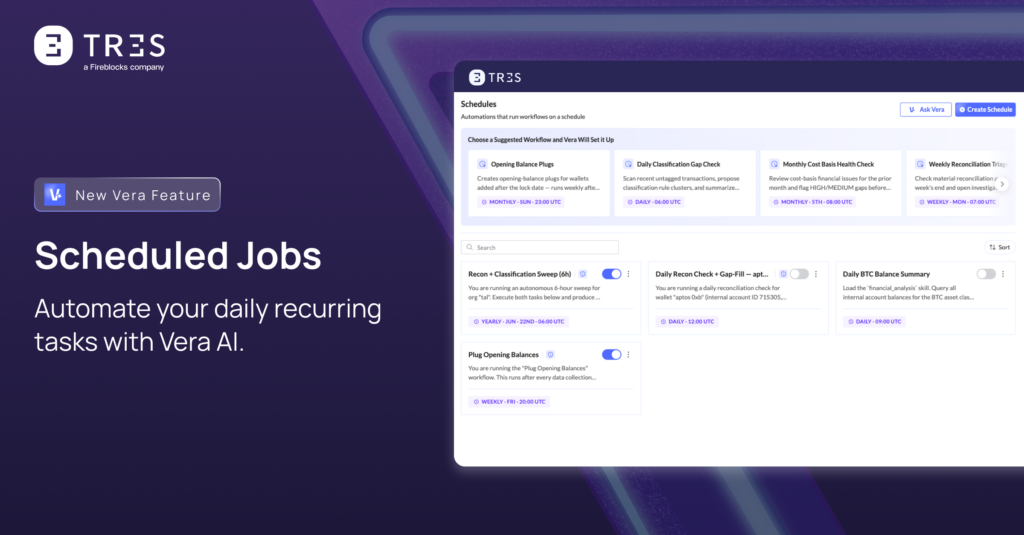
Once created and enabled, a custom skill merges into Vera’s skill set at chat time. It is available through the same interface as any built-in skill and behaves identically in use. It can be triggered on demand or run on a schedule. Disabled skills stay out of the way. No code changes are required to add, edit, or remove one, so the finance team owns the definition end to end.
The design principle is narrow and deliberate. TRES does not guess at the method. The team that owns the method states it, and Vera executes it with the same consistency it applies to anything else.
What does this look like in your live environment?
- Plug opening balances for new wallets. Creates opening-balance plug transactions for any wallet added to the ledger after a specified cutoff date. Runs on demand or on a schedule.
- Monthly weETH revalue. “Set fiat pricing to the lowest monthly amount for weETH.” One sentence, previously executed by hand by a senior analyst every month. Now a skill.
- Gas fee audit. Produces a wallet activity report, one row per wallet, in the specific layout the organization’s auditors have accepted.
- Wallet activity report generation. Structured output, one row per wallet, for reporting cycles.
- Monthly close staking-rewards process. The full staking-rewards procedure, specific to the organization’s token mix and ERP mapping.
The range matters as much as the examples. Some of these are period-end procedures, some are reporting routines, and some are rules that apply whenever a given condition appears in the ledger. All of them existed before Custom Skills, as habits and as documents. What changed is that they now execute the same way every time, regardless of who is at their desk or who is still with the company.
Why does this matter for your team?
The gap between an AI assistant that demos well and one that is useful in daily accounting operations is not defined through its raw capability. It’s defined by its institutional knowledge. Generic tools do not know how a given team handles weETH. They do not know which report layout an auditor has already signed off on. They do not know the tagging convention a controller set eighteen months ago.
Custom Skills closes that gap completely, without an engineering dependency. The procedure gets written once, in plain language, by the people who own it. After that it is repeatable, auditable, and no longer dependent on a single person’s memory.
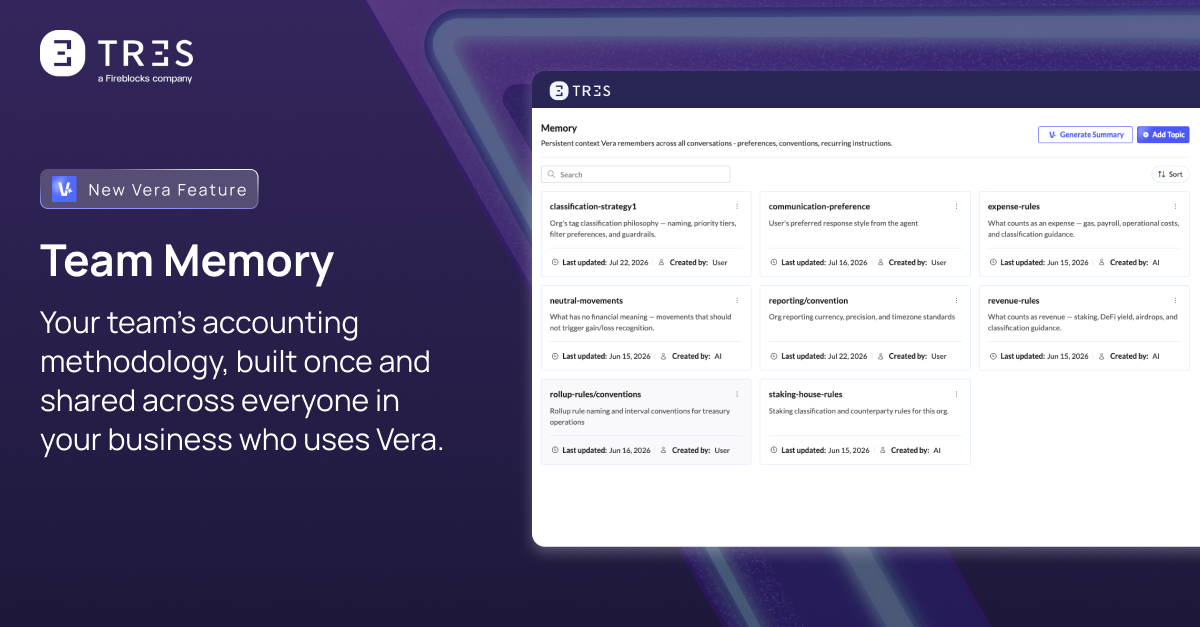
Paired with Vera’s Team Memory, it goes even further. Team Memory holds what your team knows: the rules, mappings, conventions and thresholds that govern how your entity treats activity. Custom Skills holds what your team does: the procedures themselves, step by step. Facts and methods, both written once and both applied on every task from then on. Together they are the difference between an assistant that has to be briefed every session and one that already understands your operation.
The most useful AI assistant for a finance team is not simply the most ‘capable’ one. It is the one that has been told exactly how your company manages its workflows and how your team specifically accounts for different activities. That’s real intelligence. That’s Vera.
Interested in TRES?