






Your team know things that your data never will.
Your ledger can tell you what moved, when, and where it went. It cannot tell you how your entity treats it. That decision was made months ago by someone on your team, and it now lives in three places: their head, a document nobody opens, and the chat history of whoever explained it last.
That is the real bottleneck in digital asset accounting. Not the first time you explain your methodology. The tenth.
An assistant that forgets is worse than no assistant
This is the part most AI in finance gets wrong. Raw capability stopped being the constraint a while ago. Retention is the constraint.
A system that classifies staking rewards correctly in January and forgets the rule by March has saved your team nothing. It has introduced inconsistency into the ledger, and inconsistency is exactly what an auditor finds. You end up reviewing its work as closely as a new hire’s, every session, indefinitely.
What Team Memory does
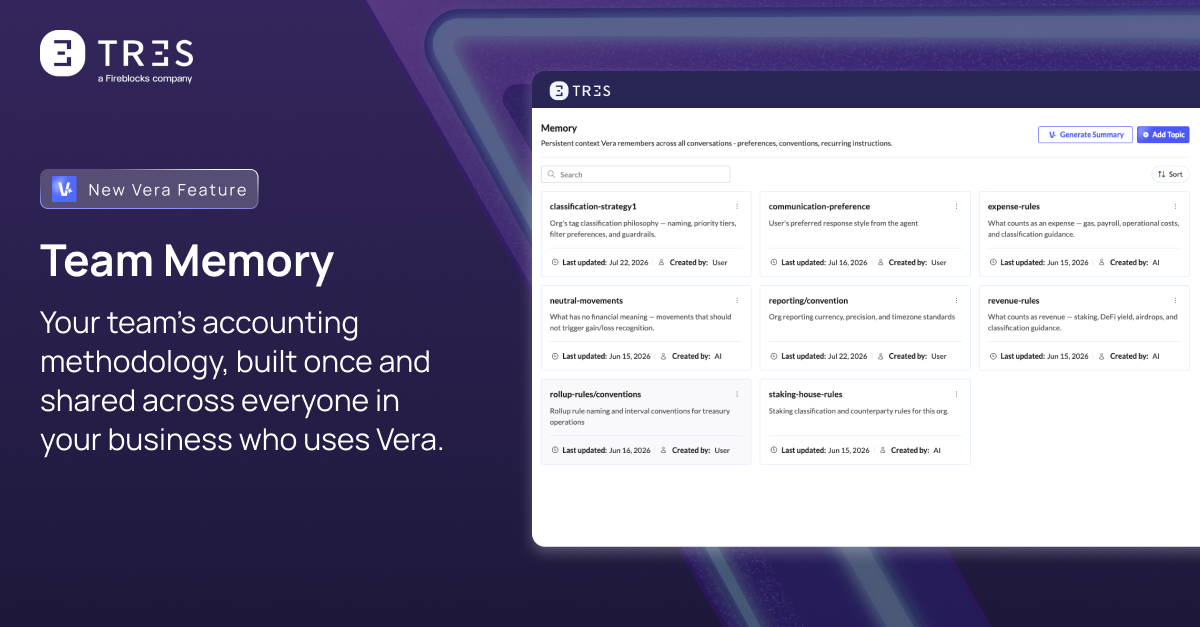
Team Memory is a persistent, per-organisation store of durable facts. It holds accounting rules, ERP mappings, wallet conventions, and thresholds. Anything that should carry across conversations rather than be re-explained each time.
Vera reads this memory before acting on every message. It also writes to it continuously: on every message, Vera runs a save check that captures lasting org rules even when they surface inside an unrelated task. Only durable knowledge is saved, never one-off task details.
Team Memory is versioned per topic, writable by both Vera and your team directly from the dashboard, and scoped per organisation so nothing crosses between accounts.
What Team Memory looks like in practice
Team Memory is already live today, and your organisation writes the entries. Every convention that currently lives in someone’s head, or in a document nobody opens, gets written into the store once, and Vera reads it before it acts on anything. No prompt engineering, no re-explaining at the start of each session. You write the rule, and it holds.
- How liquid staking tokens are treated differently from native ones.
- How to treat a vault deposit and its matching withdrawal.
- How to handle a swap or bridge where a single hash produces both an outgoing and an incoming leg.
- The threshold below which dust movements are ignored rather than flagged for review.
This is what closes the gap between what your data shows and what your organisation knows. On-chain and off-chain activity tells you what moved. It cannot tell you how your entity treats it. Team Memory holds that second half, and applies it on every task from then on.
Why this matters
The methodology your team has built over months of Vera usage accumulates in the store, gets applied on every future task, and does not disappear when the session ends. Institutional knowledge stops walking out of the door when someone changes role.
That is the difference between an assistant and infrastructure.
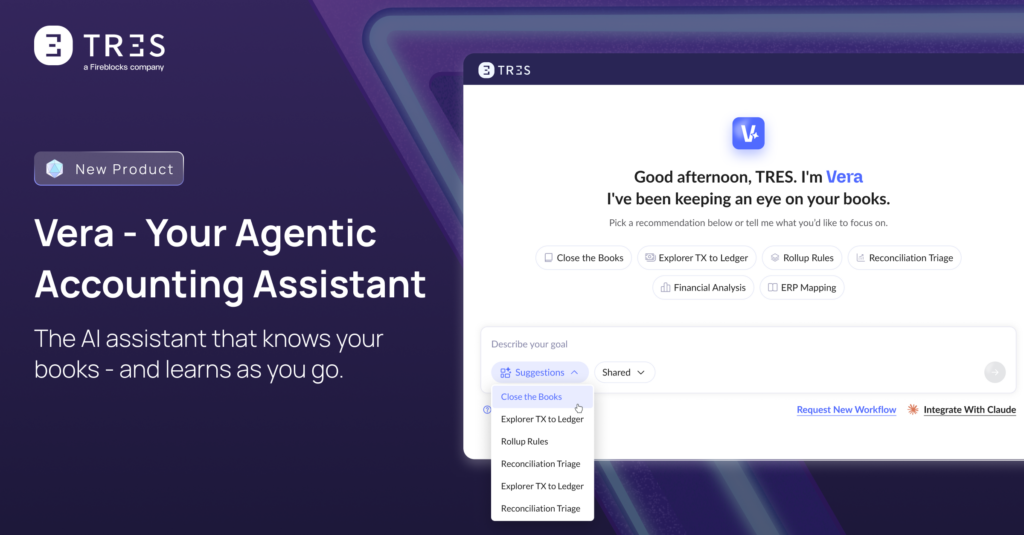
New to Vera? Read the full introduction to our agentic accounting assistant here: Introducing Vera
Interested in TRES?