






Managing a digital asset treasury isn’t just a treasury question – it’s an accounting, tax, controls, and governance question all at once. Here’s what finance teams need to know.
Fair Value Accounting Is Now the Standard
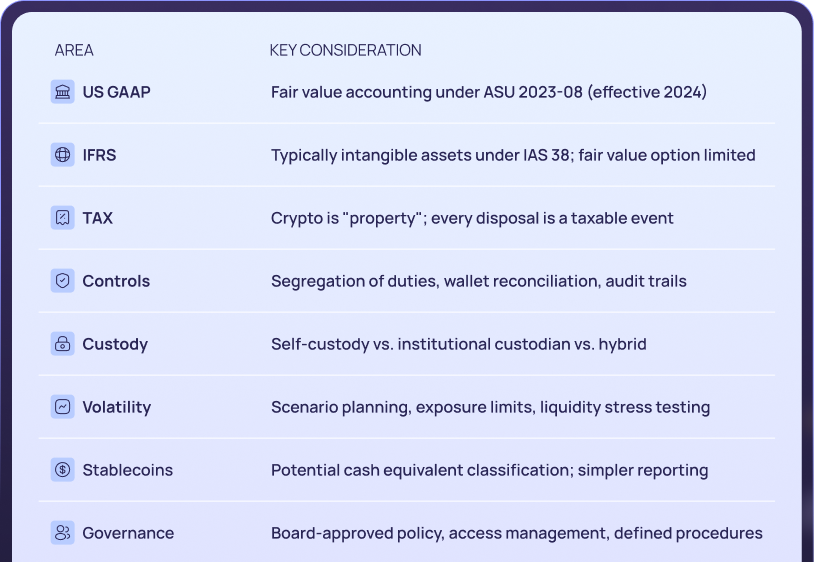
FASB’s ASU 2023-08, replaced the old impairment-only model for qualifying crypto assets. Holdings are now marked to fair value. No more recognizing losses but never gains until disposal. Scope matters: the standard applies to qualifying crypto assets under ASC 350-60, not all digital assets. Under IFRS, most holdings remain intangible assets under IAS 38 and both Cost less impairment & Revaluation models are applicable for subsequent measurement
Tax: Every Disposal Is a Taxable Event
The IRS classifies crypto as property, not currency. That means every sale, exchange, or payment in digital assets triggers a gain or loss calculation except for Internal Transfers. For high-volume treasury operations, cost-basis tracking isn’t optional – it is a compliance requirement and maintaining that data in Excel spreadsheets is no longer feasible particularly with increasing regulatory reporting and tight deadlines
Controls and Audit Readiness
Crypto doesn’t come with bank statements. Finance teams are responsible for building the audit trail from scratch: on-chain wallet reconciliations, custodian attestations, documented approvals, and segregation of duties. Without this, SOX compliance is at risk and auditors will flag it. Common gaps: poor access controls, no formal audit trail, incorrect asset classification, missing transaction labeling, inadequate segregation of duties.
Custody Structure
Three models, each with different risk and operational profiles:
– Self-custody – complete control along with complete responsibility for key management
– Institutional custodian – insurance coverage, independent audits, operational overhead
– Hybrid – flexibility, but requires clear policy on what lives where.
Volatility and Liquidity
Even a 5-10% crypto allocation can move significantly month to month. Stress testing and scenario planning aren’t optional for CFOs – debt maturities and liquidity requirements don’t flex with token prices. Most companies cap exposure relative to total liquid assets for exactly this reason.
Stablecoins and Tokenized Assets
Regulated stablecoins and tokenized T-bills can qualify as cash equivalents in some structures, simplifying liquidity management across jurisdictions. Tokenized securities offer money market-aligned yields; programmable sweeps between stablecoins and yield-bearing instruments are increasingly operational, not experimental.Tokenized RWAs offer advantages of fractional ownership, enhanced liquidity, access to global investors & transparent blockchain record-keeping
Governance
A board-approved crypto treasury policy should define: allocation limits, acceptable risk range, operational use cases (payments, debt, fundraising), access controls, and review cadence. Governance here is not static – it needs to evolve with the regulatory environment.
The Landscape Is Still Moving
FASB has signaled further standard-setting and the SEC continues to issue guidance for US companies. Other regulatory frameworks are established already in key crypto jurisdictions such as MiCA in Europe & Multi-regulator (VARA/ADGM/DIFC/CMA) framework in UAE. Companies entering this space should engage auditors and legal counsel early – retrofitting controls is significantly more expensive than building them right from the start
This is exactly the complexity TRES is built for. Our platform gives finance teams real-time visibility into digital asset positions, automated reconciliations, and audit-ready reporting. From Proof of Funds, to Staking Data, Agentic Accounting, and more, achieve complete compliance for your digital asset operations with our solutions.
Book a demo with one of our CPA-certified customer success team members now.
Interested in TRES?