





Boards are pushing CFOs to deploy AI. The market is shipping tools faster than governance frameworks can keep up. And finance teams are stuck on a single, structural challenge: how to feed AI models with their financial data without losing accuracy, control, or audit-readiness.
MCP solves that.
By the time you finish this article, you’ll understand why MCP is the keystone of any serious AI architecture in finance, and you’ll be a step ahead of 90% of finance teams still treating AI as a nice-to-have. Let’s see how.
The 30-second definition
MCP stands for Model Context Protocol. It is an open standard, introduced by Anthropic in late 2024 and now adopted by OpenAI, Google, Microsoft, and most major AI providers. It defines how AI assistants connect to external systems and data sources.
Think of it as the USB-C of enterprise AI: a single, standardized interface that replaces the dozens of bespoke integrations finance teams would otherwise need to build, maintain, and audit individually. Imagine the chaos if every computer, every phone, every charger used a different plug. That’s exactly where AI integrations sit today, without MCP.
Before MCP, every AI tool needed a custom-built connection to every data source. That meant brittle integrations, inconsistent permissions, no centralized logging, and a security review for each pairing.
After MCP, one endpoint serves them all under a single governance model.
The Technical Architecture, Without the Jargon
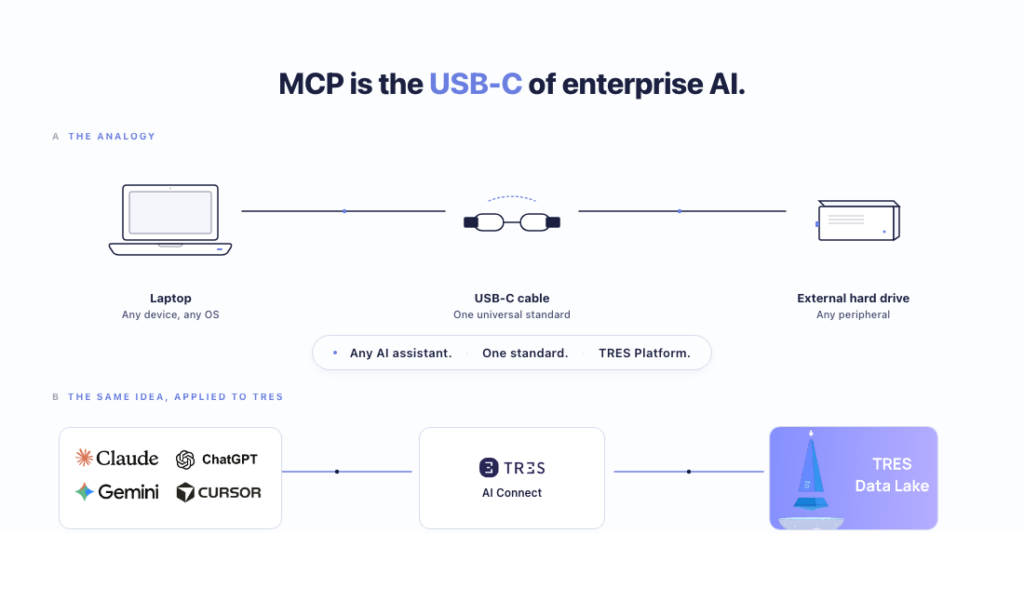
An MCP setup has three components. The USB-C analogy holds the whole way through.
The AI assistant (the laptop or phone): the system getting the data. This could be Claude, ChatGPT, Cursor, or an internal AI agent like a treasury automation script or a compliance monitor.
The MCP server (the USB-C port): the standardized endpoint that translates the assistant’s request into the right calls against the underlying systems. Built and hosted by the system vendor (TRES, Slack, your CRM).
The connected systems (the device behind the port): the actual financial systems holding the data: ERPs, custodians, accounting platforms, banks, TRES.
The assistant never talks to the underlying systems directly. It talks to the MCP server, which handles authentication, applies access controls, executes the request against the right system, and returns a structured response. Every step is logged.
This matters because it inverts the traditional integration model. Instead of N AI tools each maintaining their own connections to M data sources (an N×M problem), you have N assistants talking to one MCP server that maintains M connections (an N+M problem).
What an MCP server actually exposes
When a finance system speaks MCP, it exposes three things to any compatible AI assistant:
- Tools. Discrete actions the AI can request or do: get_balance, list_transactions, run_reconciliation, generate_audit_report. Each has a defined input and output, validated by the server before execution.
- Resources. Read-only data the AI can access: ledgers, journals, historical balance snapshots, transaction logs. Addressable through standardized references.
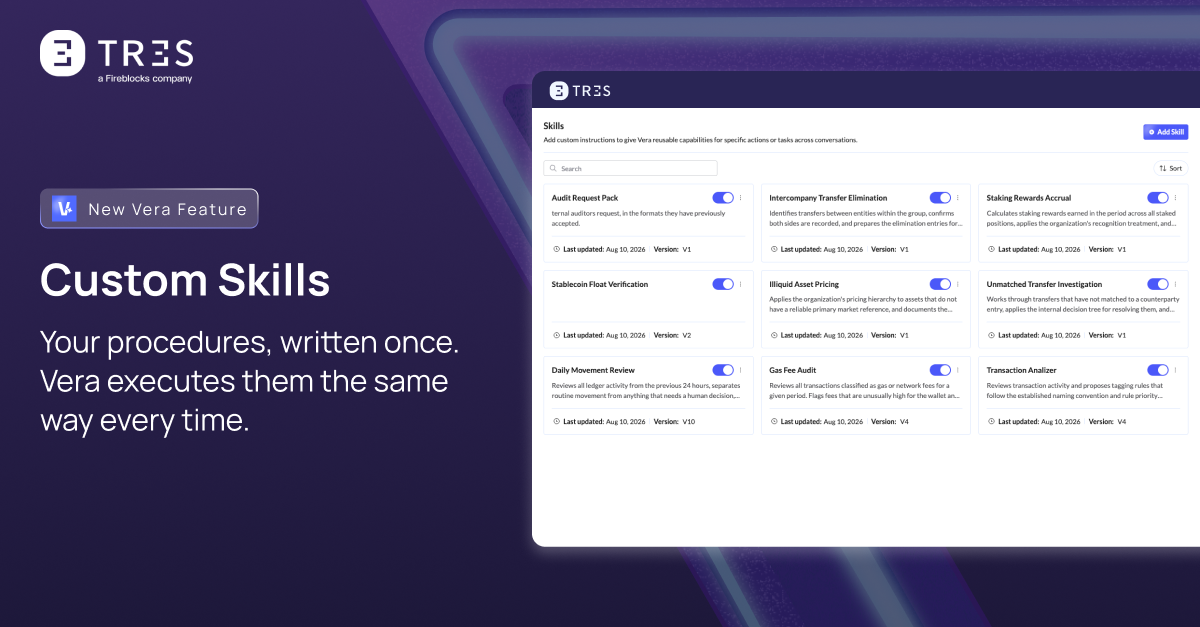
- Prompts / Skills. Pre-defined templates the system can offer the AI to make sure questions get asked the right way and processes are controlled.
Three primitives, covering the full range of how an AI can read, act, and follow established patterns inside a finance system.
Why CFOs should care, and what to look for
The traditional finance technology stack was not designed for AI agents to query it autonomously. Your team has a responsibility to learn how to use AI, but none of that effort pays off until your tools adapt to the AI frameworks, which, as you now know, MCP solves for.
For every tool in your stack, three questions now matter:
Is it MCP-ready? How is your data and your functions connected to AI? Without an MCP layer in place, you can’t deploy AI on top of that system. The integration becomes the bottleneck before you’ve even started.
Can you trust what comes back? AI is not deterministic. We’ve all been victims of hallucinations: confident-sounding answers that are subtly or completely wrong. In finance, that’s not a quirk, it’s a liability. The responsibility for trust sits with your tool provider as much as with you. How well is the MCP server built? Does it expose pre-defined Skills and Prompts that constrain the AI to the right workflows? A well-designed MCP server doesn’t just give the AI access, it guides it away from the failure modes that produce hallucinations in the first place.
Is it usable in practice? A finance team won’t adopt a tool that takes a developer to operate. The whole point of AI assistants is to put the system of record one prompt away from the people who actually need the answer. If the MCP integration requires custom code or specialist training every time someone wants to ask a question, the value proposition collapses.
By now you’ve realized that without a properly standardized connection between your tools and your team, the solution is half-baked and risks being inaccurate. It’s not only about having an MCP, but about how it has been built. With accuracy at the core.
TRES AI Connect: A working example
TRES AI Connect is the MCP server that connects your TRES account to any MCP-compatible AI assistant: Claude, ChatGPT, Cursor, or any internal agent your team builds.
We built it with accuracy at the core. The endpoint points to the right data, every time. And our team built a library of Skills and Prompts on top of it, so the AI doesn’t have to guess what a good question looks like. It runs the workflow your finance team would have run, just faster.
AI Connect exposes the full TRES platform through a single, secure endpoint:
- FinOS: ledger, cost basis, journal entries, ERP-ready exports
- Reconciliation Engine: on-chain versus internal record matching across wallets, exchanges, and custodians
- Proof of Funds: historical balance snapshots down to the millisecond
- Staking Data API: daily reward data across supported chains
When a user asks a question, the AI assistant routes it through TRES AI Connect. The server authenticates the user, applies their TRES permissions, executes the request against the right combination of systems, and returns a structured, audit-ready answer. Every query logged. Every action traceable. No data leaves the controlled environment.
Where this is going
MCP is still early. The protocol launched in late 2024 and has quickly become the standard. For finance, the trajectory is clear: the tools used to close books, run audits, manage treasury, and monitor compliance will increasingly speak MCP natively.
Once you realize how good it is, and how much it simplifies your day-to-day, you will start asking every provider the same question: do you have an MCP?
Teams that build their AI strategy on top of MCP-aware infrastructure will move faster than teams stitching together one-off integrations. The competitive surface for finance technology is moving up the stack: away from “who can connect AI to my systems” and toward “who designs the best agentic finance workflows on top of those connections.”
For TRES customers, that future is already here.
Want to see TRES AI Connect in action? Schedule a demo and see how AI assistants can query your digital asset financial data with full audit traceability built in.
Interested in TRES?