






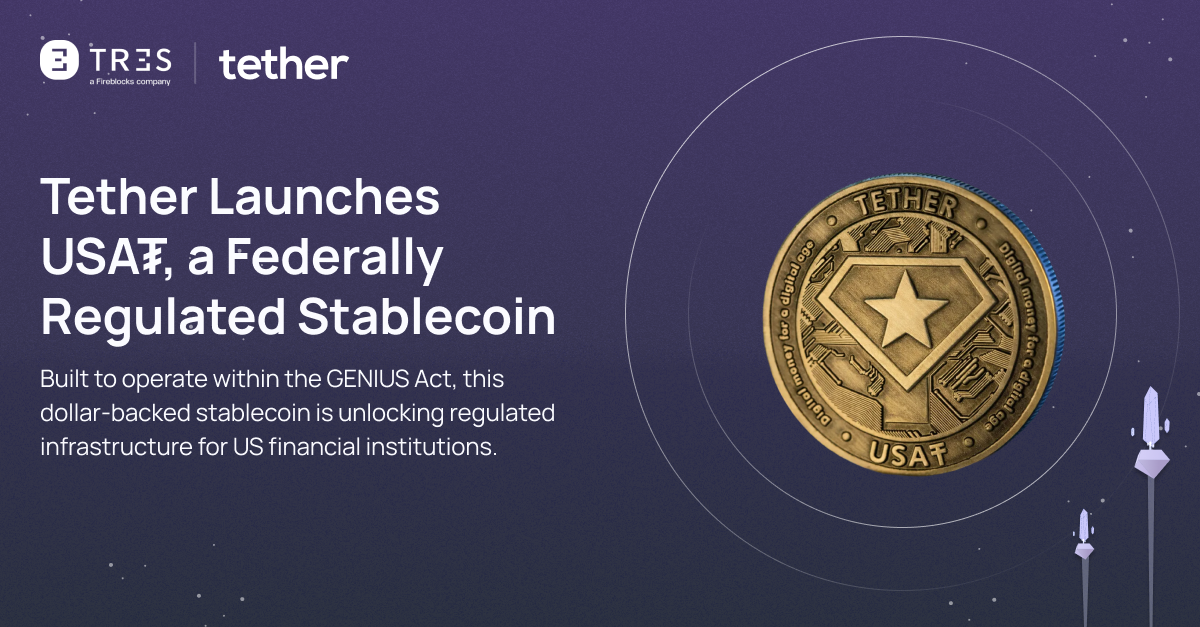
Tether’s federally regulated stablecoin isn’t just another token launch. It signals that the U.S. regulatory framework is now an accelerant for institutional adoption, not a barrier.
On January 27, 2026, Tether launched USA₮, its federally regulated, dollar-backed stablecoin designed specifically to operate within the GENIUS Act framework. Issued by Anchorage Digital Bank, N.A., with Cantor Fitzgerald as reserve custodian, this marks a turning point for how institutions can engage with digital dollars in the United States.
The launch is an adaptation. And it signals maturity for the entire digital asset ecosystem.
Tether’s Adaptation to the GENIUS Act
The U.S. understood that the scale of stablecoin activity had reached a point where regulatory clarity wasn’t optional. It was essential. The GENIUS Act, passed in July 2025, was the answer, establishing the first comprehensive federal framework for payment stablecoins in the United States. The law fundamentally changed the rules of engagement:
- Issuer requirements: Only federally or state-qualified entities can market stablecoins to U.S. users
- Reserve standards: One-to-one backing with high-quality liquid assets (USD, Treasuries, money market funds)
- Ongoing supervision: Disclosure requirements, executive certification, and audits for issuers above $50 billion
- Compliance obligations: Bank Secrecy Act, anti-money laundering, and sanctions compliance programs
Offshore-issued stablecoins that don’t meet these standards now face restrictions across U.S.-regulated exchanges, banks, and payment platforms. The regulatory environment that once created ambiguity now creates clarity.
Ecosystem Maturity
The USA₮ launch reflects broader maturation across the digital asset ecosystem. The narrative has evolved from decentralization at all costs to integration with regulatory frameworks as the path to scale. Tether is leading with pragmatism.
Tether’s dual-product approach (USDT for global markets, USA₮ for U.S. institutional use) parallels how international financial institutions structure their operations: different regulatory wrappers, same underlying function. This defines a playbook for every issuer.
USDT alone commands a market capitalization of $186 billion as of January 29, 2026, with the total stablecoin market exceeding $300 billion in circulation.
The transaction volumes tell an even more compelling story. According to Andreessen Horowitz’s State of Crypto 2025 report, stablecoins processed $46 trillion in total transaction volume over the past year. That’s nearly three times Visa’s annual volume and approaching the scale of the U.S. banking system’s automated clearing house network.
Monthly adjusted transaction volume hit an all-time high of $1.25 trillion in September 2025, with activity largely decoupled from broader crypto trading. This is evidence of substantive economic use beyond speculation.
And the broader financial ecosystem has taken notice. Stripe now enables stablecoin payments for millions of Shopify merchants across 34 countries and launched Stablecoin Financial Accounts in 101 countries. PayPal offers PYUSD with 4% rewards and has expanded to Ethereum, Solana, and Stellar. Visa has expanded stablecoin settlement support across four blockchains (Ethereum, Solana, Stellar, Avalanche) and multiple stablecoins (USDC, USDG, PYUSD, EURC). Mastercard has enabled stablecoin spending at over 150 million merchant locations and announced support for USDG, PYUSD, USDC, and Fiserv’s FIUSD. Interactive Brokers launched 24/7 stablecoin account funding through Zero Hash, allowing clients to fund brokerage accounts instantly with USDC, RLUSD, and PYUSD.
This is no longer experimental infrastructure. Stablecoins have become a core settlement layer for global finance.
Regulation as an Accelerant: A Safety Net for CFOs
The GENIUS Act didn’t create hesitation among institutions. It created confidence.
Clear rules for issuers define what’s required, clearing the field. Clarity for users and holders establishes legality and backing (one-to-one reserves and ongoing supervision). CFOs now have legal clarity. Boards have risk frameworks they understand. Compliance teams have defined requirements instead of ambiguous guidance.
For CFOs and finance leaders evaluating stablecoin strategy, three implications stand out:
- Operating in stablecoins is legal and secure in jurisdiction. The rails are ready. The regulatory framework exists. The compliance pathway is defined. Institutions can now engage with confidence.
- The infrastructure is ready to incorporate stables to your treasury. Fireblocks secures the movement of digital dollars with institutional-grade custody, policy controls, and direct integrations across exchanges, banks, and DeFi protocols.
- Staying compliant requires full visibility of your treasury, movements, and positions. TRES makes stablecoin activity legible to finance teams: reconciliation, reporting, and audit-readiness across every wallet, chain, and issuer.
Regulation: Ready. Infrastructure: Ready. Audit Readiness: Ready.
It’s time to operate faster, and in real time, with stablecoins.
Interested in TRES?